Thirsty data centres, thin regulation: Who is watching India’s water?None of the major state data centre policies in India currently require o...
Published by Water Network Research, Official research team of The Water Network
Thirsty data centres, thin regulation: Who is watching India’s water?
None of the major state data centre policies in India currently require operators to disclose water consumption through a centralised reporting system
Thirsty data centres, thin regulation: Who is watching India’s water?
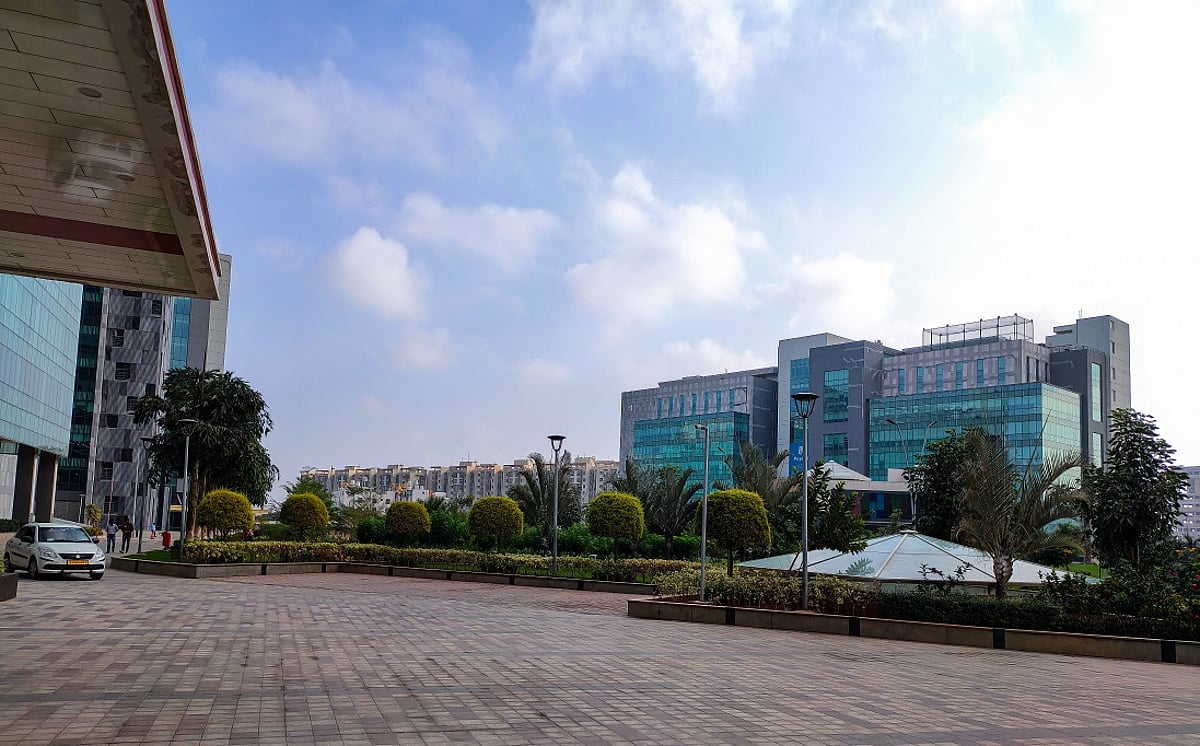
The premises of an IT company in Bengaluru.Photo: iStock
Shruthi Srinivasan
Tania Sebastian
Shruthi Srinivasan, Tania Sebastian
Published on:
21 Aug 2026, 11:02 am
Listen to this article
Summary
India’s rapid AI expansion is driving a massive build-out of water-intensive data centres, yet regulation has not kept pace with the sector’s growing water footprint.
With facilities concentrated in already stressed cities like Bengaluru, Mumbai and Chennai, weak monitoring, disclosure and planning threaten long-term water security unless stronger safeguards and efficiency standards are embedded now.
India’s Artificial Intelligence (AI) boom represents a once-in-a-lifetime economic opportunity. With one of the highest rates of AI adoption among enterprises globally and billions of rupees committed through the IndiaAI Mission, the country is rapidly emerging as a leader in the AI revolution. The question is whether India’s regulatory framework is evolving quickly enough to ensure that the infrastructure powering this growth remains sustainable, particularly when it comes to managing the significant water resources required to cool and operate data centres.
According to IBM’s global research, 59 per cent of Indian enterprises have already adopted AI — the highest share among all countries surveyed. Deloitte similarly ranks India first in Generative AI adoption across the Asia-Pacific region. The Government of India (GoI)has reinforced this momentum through the IndiaAI Mission, committing Rs 10,300 crore over five years to accelerate the country’s AI ecosystem. As AI adoption scales, every query is ultimately powered by data centres — the thirsty physical infrastructure that consumes significant volumes of water for cooling. As India scales this infrastructure, it has an opportunity to build regulatory safeguards that protect critical resources such as water while supporting the country’s long-term economic ambitions.
India generates nearly 20 per cent of the world’s data but currently accounts for only 3 per cent of global data centre capacity. As the country seeks to bridge this infrastructure gap, data centre capacity has expanded fourfold — from about 375 MW in 2020 to nearly 1,500 MW in 2025 — with further growth expected in the coming years. This rapid expansion is driving a parallel surge in demand for cooling infrastructure, which the Office of the Principal Scientific Adviser to the GoI estimates will grow from a US$ 2.1 billion industry today to more than US$ 7 billion by 2030. Cooling, however, depends heavily on water. Data centres are already estimated to consume around 150 billion litres of water annually nationwide, a figure projected to more than double by the end of the decade. As India scales the infrastructure underpinning its AI ambitions, managing this growing water footprint will become an increasingly important policy challenge.
This challenge is particularly pronounced in Karnataka, which reportedly hosts approximately 32 data centres, nearly 30 of them concentrated in Bengaluru — a city that has faced recurring water shortages in recent years. According to Deloitte’s projections, a single 20 MW data centre can consume roughly 1.4 million litres of water per day, equivalent to the daily needs of around 27,000 urban households. This additional demand comes at a time when Bengaluru already relies on nearly 2,000 MLD of water from the Cauvery to meet citywide demand that can reach as high as 3,000 MLD, while thousands of government-operated borewells are reportedly running dry.
Against this backdrop, Karnataka’s Data Centre Policy commits to ensuring uninterrupted water access for data centres on a 24/7 basis, without expressly specifying how competing demands for water would be managed during periods of scarcity. This governance gap is becoming increasingly relevant as the state’s data centre footprint continues to expand, with several new facilities already in the pipeline.
The challenge is not unique to Karnataka. Mumbai and Chennai together account for roughly 70 per cent of India’s data centre capacity as of 2025, despite both cities facing well-documented water stress. A significant share of India’s thirsty AI infrastructure is being concentrated in regions least equipped to absorb additional water demand.
There are lacunae
Existing policy frameworks provide limited visibility into how this growing demand is being managed. None of the major state data centre policies currently require operators to disclose water consumption through a centralised reporting system. As a result, regulators may lack the information needed to identify emerging risks and intervene before local water stress intensifies.
These gaps are particularly relevant given India’s broader exposure to water risk. Planet Tracker ranks India second only to Indonesia among Asian countries in the number of data centres located in areas classified as experiencing “extremely high” water stress. In this context, the absence of robust monitoring, reporting and verification (MRV) mechanisms makes it difficult for policymakers, investors and communities to assess whether water-use commitments are being met, whether mitigation measures are effective, and where emerging risks may require intervention. As a result, the gap between policy intent and operational reality can remain difficult to detect.
This matters because data centres are long-lived assets that will shape resource-use patterns for decades.
None of the major state data centre policies in India currently require operators to disclose water consumption through a centralised reporting system
Thirsty data centres, thin regulation: Who is watching India’s water?
The premises of an IT company in Bengaluru.Photo: iStock
Shruthi Srinivasan
Tania Sebastian
Shruthi Srinivasan, Tania Sebastian
Published on:
21 Aug 2026, 11:02 am
Listen to this article
Summary
India’s rapid AI expansion is driving a massive build-out of water-intensive data centres, yet regulation has not kept pace with the sector’s growing water footprint.
With facilities concentrated in already stressed cities like Bengaluru, Mumbai and Chennai, weak monitoring, disclosure and planning threaten long-term water security unless stronger safeguards and efficiency standards are embedded now.
India’s Artificial Intelligence (AI) boom represents a once-in-a-lifetime economic opportunity. With one of the highest rates of AI adoption among enterprises globally and billions of rupees committed through the IndiaAI Mission, the country is rapidly emerging as a leader in the AI revolution. The question is whether India’s regulatory framework is evolving quickly enough to ensure that the infrastructure powering this growth remains sustainable, particularly when it comes to managing the significant water resources required to cool and operate data centres.
According to IBM’s global research, 59 per cent of Indian enterprises have already adopted AI — the highest share among all countries surveyed. Deloitte similarly ranks India first in Generative AI adoption across the Asia-Pacific region. The Government of India (GoI)has reinforced this momentum through the IndiaAI Mission, committing Rs 10,300 crore over five years to accelerate the country’s AI ecosystem. As AI adoption scales, every query is ultimately powered by data centres — the thirsty physical infrastructure that consumes significant volumes of water for cooling. As India scales this infrastructure, it has an opportunity to build regulatory safeguards that protect critical resources such as water while supporting the country’s long-term economic ambitions.
India generates nearly 20 per cent of the world’s data but currently accounts for only 3 per cent of global data centre capacity. As the country seeks to bridge this infrastructure gap, data centre capacity has expanded fourfold — from about 375 MW in 2020 to nearly 1,500 MW in 2025 — with further growth expected in the coming years. This rapid expansion is driving a parallel surge in demand for cooling infrastructure, which the Office of the Principal Scientific Adviser to the GoI estimates will grow from a US$ 2.1 billion industry today to more than US$ 7 billion by 2030. Cooling, however, depends heavily on water. Data centres are already estimated to consume around 150 billion litres of water annually nationwide, a figure projected to more than double by the end of the decade. As India scales the infrastructure underpinning its AI ambitions, managing this growing water footprint will become an increasingly important policy challenge.
This challenge is particularly pronounced in Karnataka, which reportedly hosts approximately 32 data centres, nearly 30 of them concentrated in Bengaluru — a city that has faced recurring water shortages in recent years. According to Deloitte’s projections, a single 20 MW data centre can consume roughly 1.4 million litres of water per day, equivalent to the daily needs of around 27,000 urban households. This additional demand comes at a time when Bengaluru already relies on nearly 2,000 MLD of water from the Cauvery to meet citywide demand that can reach as high as 3,000 MLD, while thousands of government-operated borewells are reportedly running dry.
Against this backdrop, Karnataka’s Data Centre Policy commits to ensuring uninterrupted water access for data centres on a 24/7 basis, without expressly specifying how competing demands for water would be managed during periods of scarcity. This governance gap is becoming increasingly relevant as the state’s data centre footprint continues to expand, with several new facilities already in the pipeline.
The challenge is not unique to Karnataka. Mumbai and Chennai together account for roughly 70 per cent of India’s data centre capacity as of 2025, despite both cities facing well-documented water stress. A significant share of India’s thirsty AI infrastructure is being concentrated in regions least equipped to absorb additional water demand.
There are lacunae
Existing policy frameworks provide limited visibility into how this growing demand is being managed. None of the major state data centre policies currently require operators to disclose water consumption through a centralised reporting system. As a result, regulators may lack the information needed to identify emerging risks and intervene before local water stress intensifies.
These gaps are particularly relevant given India’s broader exposure to water risk. Planet Tracker ranks India second only to Indonesia among Asian countries in the number of data centres located in areas classified as experiencing “extremely high” water stress. In this context, the absence of robust monitoring, reporting and verification (MRV) mechanisms makes it difficult for policymakers, investors and communities to assess whether water-use commitments are being met, whether mitigation measures are effective, and where emerging risks may require intervention. As a result, the gap between policy intent and operational reality can remain difficult to detect.
This matters because data centres are long-lived assets that will shape resource-use patterns for decades.
Tags
- IT
- Data Management
- Data & Analysis
- India
- artificial intelligence
- Groundwater Data Scientist
- India